

The Fundació Institut Guttmann is a private, non-denominational, non-profit entity, established by Catalan civil society. It is an efficient example of a public-private partnership. It holds registration number 189 in the Register of Private Foundations of the Generalitat de Catalunya’s Department of Justice. Classified as a caring charitable organisation since 1965, it is considered a beneficiary of patronage in accordance with Law 49/2002, of 23 December, “on the tax regime of non-profit entities and tax incentives for patronage”. Since its constitution in 1962, its Articles of Association establish the foundation’s objectives and operation.


Follow-up of the Strategic Plan 2020-2025
The 2021 Programme included the objectives set to be developed during the year, looking towards new lines of activities and services based on neurorehabilitation and the promotion of brain health. 2021 was significantly influenced by the Covid-19 pandemic, affecting the achievement of some of the objectives set in the follow-up to the Strategic Plan. However, and despite the pandemic, the Fundació Institut Guttmann has achieved 94.04% global compliance with its objectives.
The new Strategic Plan 2020-2025 reflects the mission, vision and institucionals values.
> Institutional Mission, Vision and Values.
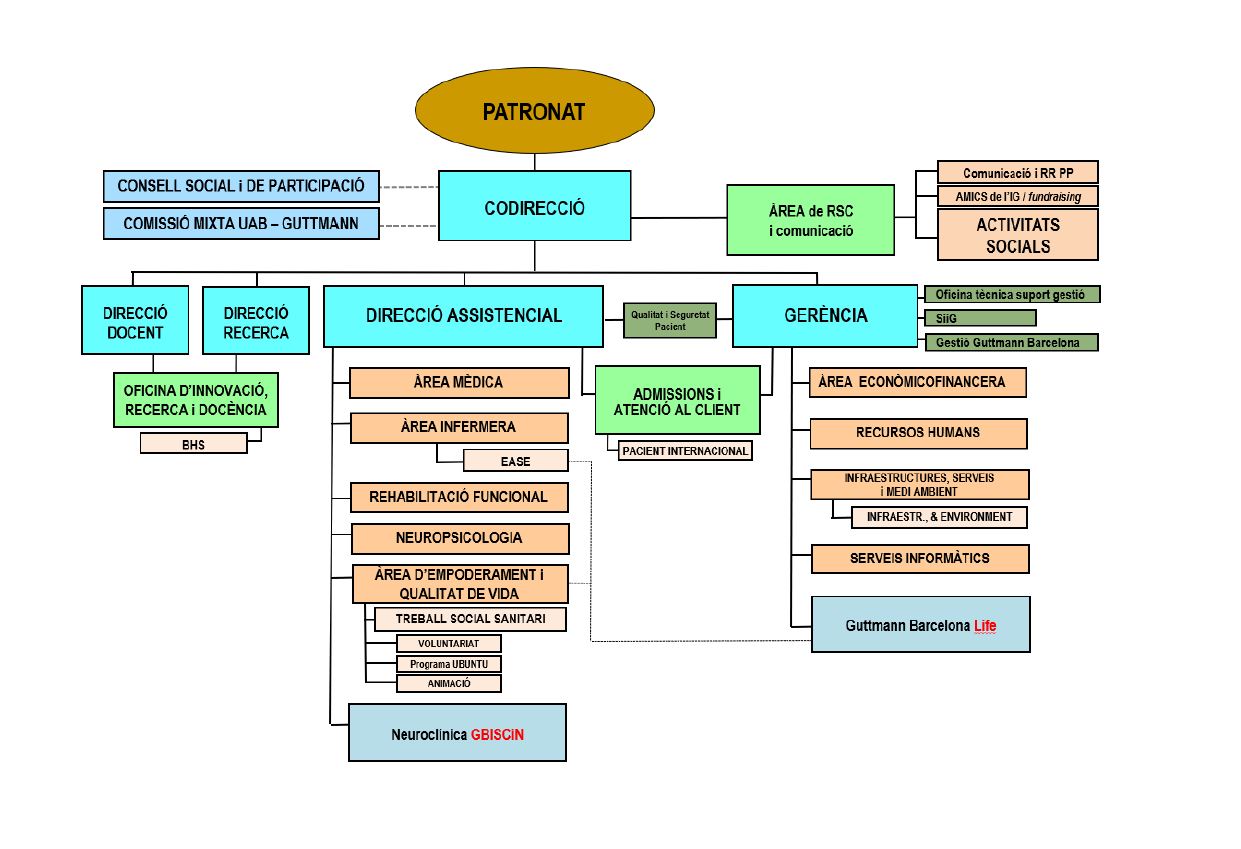
> Governing and Management Structure
In addition, in November 2021 we achieved an important milestone with the re-accreditation of the organisation with our 5th certification from the demanding and prestigious Joint Commission International, achieving 98% of the 2,000 mandatory standards. This is a great success across the whole organisation that reflects the effort and dedication of the nearly 500 people who make up the Institut Guttmann’s professional team.
Level of achievement of active objectives
| Strategic Objectives | first Q. | second Q. | anual |
|---|---|---|---|
| Overall achievement percentage | 36,68% | 80,82% | 94,04% |
| COHESION, COMPETITION, COMPETITIVENESS | 36,32% | 80,59% | 94,03% |
| NEW CENTER DEVELOPMENT | 45,96% | 91,96% | 99,08% |
| DIFFERENTIATION, INNOVATION, SPECIALIZATION, HUMANIZATION | 36,24% | 79,84% | 94,11% |
| EXCELLENCE | 36,16% | 80,44% | 94,04% |
| NEW CONCEPT OF DISABILITY | 34,38% | 82,38% | 99,69% |
| SOCIAL PRESTIGE | 38,87% | 82,30% | 96,04% |
| NATIONAL AND INTERNATIONAL REFERENCE | 40,46% | 86,04% | 94,11% |
| SUSTAINABILITY | 46,72% | 83,23% | 96,09% |
“The Institut Guttmann is a non-profit organisation whose main purpose is to promote, implement and achieve the comprehensive rehabilitation of people affected by spinal cord injury, acquired brain injury or other neurological disabilities, to carry out research and teaching in this area of neuroscience, and to give patients the best support and services possible to achieve successful social reintegration, as well as to contribute to the full recognition of their rights and equal opportunities.”
Article 7 of the Articles of Association
The foundation’s Board of Trustees
The Board of Trustees is the highest body of government and representation of the foundation. It is responsible for safeguarding, interpreting and developing the foundation’s aims expressed in its Articles of Association.
In 2021, it is worth highlighting the changes that took place in the Board of Trustees of the Fundació Institut Guttmann last June. Some appointments, set out in the articles of association, responded to the desire to renew its members, seeking a model of corporate governance of the highest level that is more sustainable over time and that would allow the institute to continue achieving excellence as a benchmark centre and leader in the field of neurorehabilitation, Therefore, Dr Antoni Esteve assumed the presidency of the Board of Trustees, replacing Mr Francesc Homs, who had been at the helm of the Fundació Institut Guttmann for the last 12 years, and Ms Núria Basi was appointed Secretary of the foundation’s Board of Trustees. We also welcomed Dr Rosa Ma. Sebastián, Ms Núria Mas, and Dr Jordi Serra, all of them as new Board members to replace Mr Francesc Homs i Ferret, Mr Miquel Vilardell, Mr Josep Arcas, and Mr Salvador Alemany. We are extremely grateful to all of them for the dedication and commitment they have given to the institute over the years..
he makeup of the Board of Trustees is published on the institute’s website.
Social and Participation Council
The Institut Guttmann created the Social and Participation Council in 2004 to reinforce its social commitment to people with neurological disabilities, whilst promoting greater interaction and cooperation with associations who represent them. This initiative favours the participation and collective responsibility of all stakeholders involved in carrying out the foundation’s activities. Its main purpose is to identify emerging needs, propose new initiatives, and collaborate in taking decisions that the Board submits for its consideration.
The makeup of the Social Council is published on the institute’s website.
Institut Guttmann – UAB Joint Committee
This is the planning and monitoring body for the academic and scientific activities of the Guttmann University Institute of Neurorehabilitation. It is formed by three representatives of the Institut Guttmann and three from the University, in order to coordinate the relationship between the two entities.
The makeup of the Committee is published on the institute’s website.
Management Team
Formed by professionals in charge of the main areas of the organisation, this team is responsible for defining and enhancing the organisational culture, driving strategic plans and leading activities that derive from the Board of Trustee’s specific mandate.
In statutory terms, the Managing Director, or CEO, is the foundation’s top executive. (In 2022 the management became a co-management.) Additionally, the institute is structured into different committees and commissions designed to monitor specific topics.
The Fundació Institut Guttmann is undergoing a time of change and generational change throughout the organisation. These changes will make the Institut Guttmann a stronger organisation that is full of talent and potential that we must be capable of transforming to the institute’s governing and management bodies.
The makeup of the management team is published on the institute’s website.