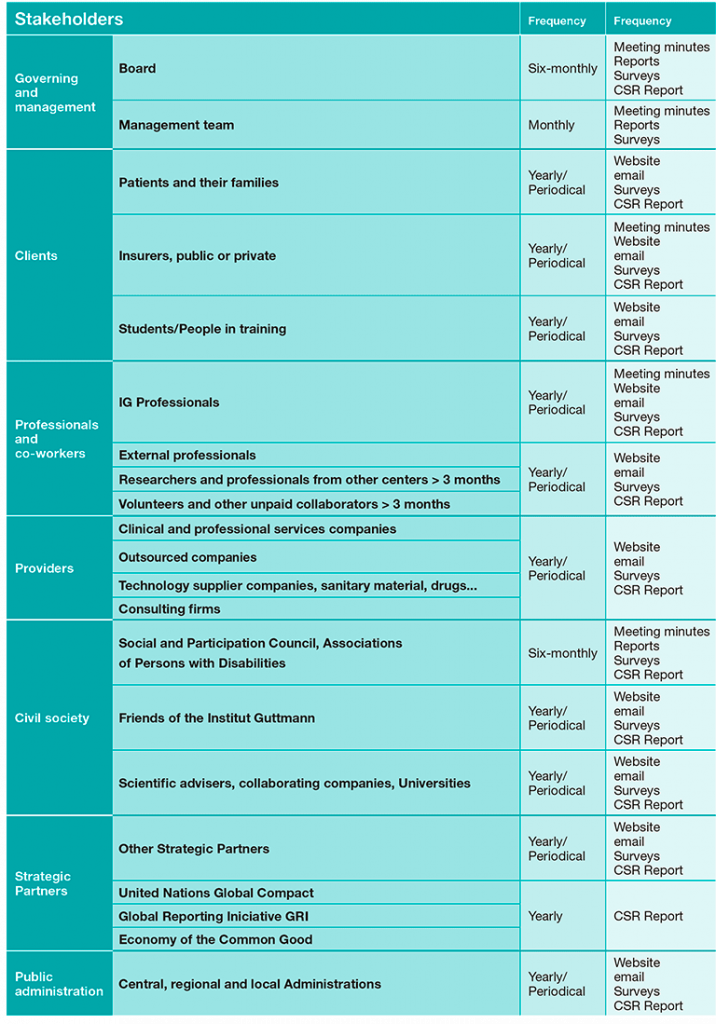


The Institut Guttmann uses a communication system that guarantees the development of a direct, fluid and two-way circuit of information with all stakeholders (detected and analysed).
Both internally and externally, communication is a first-class tool to detect, plan and satisfy one’s own information needs and those of others, working to improve the institute’s fame, social prestige and reputation, and creating partnerships with the professionals, associations of people with disabilities, entities, authorities and society in general, especially with the specific groups with which the organisation relates.

We also take care of the health of our stakeholders
Far from being something we have left in the past, the pandemic and its consequences continued to generate exceptional circumstances in the health system and also the Institut Guttmann throughout 2021. For the second year running, involvement in the fight against thedisease has aggravated stress in all health organisations and the professionals who work for them, and this can also be perceived in our institute.
Therefore, this year we have not only continued to fight against the pathology of Covid-19, but have had to double our efforts by working firmly on implementing the vaccination campaign for professionals, patients, family members, students, etc. All of this was done without neglecting our health activities and many other areas of the institute, as a result of the biosafety measures established by the Authorities.
During 2021, our Nursing staff administered some 2,600 doses of the Covid-19 vaccine to different interest groups (professional staff, students, trainee staff, patients, caregivers and family members living with professional staff members); and we carried out more than 4,100 PCR and ART tests. Additionally, in the month of August we were designated as a “Covid-19 Vaccination Centre” by CatSalut.

Regarding communication with stakeholders
The following actions were carried out in 2021:
- We have brought back our outpatient neurorehabilitation activity to pre-pandemic levels, while consolidating telemedicine and online assistance as a useful complementary activity.
- We have brought back and boosted our Volunteering programme, launched the deployment of the Humanisation Plan for patients and families, initially by renewing and reviewing the Welcome Programme at the hospital.
- We have enhanced tools to measure the satisfaction and perception of the Fundació Institut Guttmann to correctly identify points for improvement and provide better care.
- We have continued to work on research and teaching, as a Knowledge Centre, bringing back face-to-face attendance on University Master’s degrees and setting up collaboration agreements in the field of Innovation and Research.
- During 2021 we worked on the new Electronic Clinical Record that has already been implemented in all hospitalisation units and on the design of a new app for patients and families, so that they can access their personal profile and carry out procedures and requests easily and conveniently.
- We have published a new website, built around the most relevant user profiles. This extensive portal offers over 600 pages of information and more fluid and satisfactory navigation for users. Without leaving the website, they can find new information and services that may be of interest. Designed based on strategic objectives and to grow the organisation thanks to the potential offered by the Internet. Aimed at international patients and to take advantage of search engines to consolidate the Fundació Institut Guttmann on the international stage. The website receives over 270,000 visits a year and its users consult more than 590,000 pages.
- We have continued cooperating with the main associations for people with disabilities, especially those that are members of the Social and Participation Council, to develop and implement the Participa project and participation in workshops and conferences with different bodies, federations and confederations.
- In the field of Human Resources, we have promoted continuous training and measures for the prevention of occupational hazards, reviewing the professional career of requests received.
- Again in 2021, the results obtained in the Perception of User Satisfaction, both in-patients and out-patients,were 95.69% regarding the quality perceived and 94.87% regarding perceived security.
- The website, intranet and Fulls Informativo (internal communication magazine) have continued to be used to directly inform Management of any breach of the Code of Ethics, Code of Conduct or opinions, complaints and suggestions regarding CSR.
- In 2020, 28 complaints, claims and suggestions were received, 9 more than the previous year. They all received a written response within an average of 7.3 days, more than the delays of previous years (6 days in 2019 and 6,7 days in 2020). Of the total, 22 were related to the care process and 6 to services like catering and transportation by ambulance.
- As usual, our organisation’s CSR report was sent to all interest groups. Some were printed and others (the majority) were in digital format.
Supplier relationships
Suppliers of goods and subcontractors follow the same procedure for selection and adjudication within a framework of free competition and excluding any relationship or interference outside the interests of the organisation. The Institut Guttmann always demands reciprocal honesty in its commercial relations, full respect for current regulations and, in particular, that which refers to the compulsory hiring of people with disabilities; also relevant are those that refer to the protection of children, environmental protection and labour protection. It meets annually with the heads of the main subcontracted companies and ratifies the code of conduct, verifying that they are aware of its existence and performance.
The Institut Guttmann provides information on the environmental requirements that it asks of all its suppliers and hires companies that adhere to its values and principles of social responsibility:
- Extending the CSR commitment to the rest of the chain (subcontracts). – Creating a joint responsible culture externally.
- Cooperating with the development of communities impacted by its activities.
- Working to align suppliers with the institute’s strategy, as well as highlighting its best practices and ensuring the transfer of mutual knowledge.
- Holding dialogue with supplier companies as one of the institute’s interest groups.
- Monitoring effective equality between men and women and the prevention of sexual and gender-based harassment.
- Continually promoting diversity.
- Guaranteeing regulatory compliance.
- Requiring labels, certificates, policies, plans and strategies on corporate responsibility or sustainability from suppliers, as well as assessing their adherence to international corporate responsibility initiatives; environment; quality, occupational health and safety; human and employment rights, etc. (Certifications).
- Measuring the total consumption of resources needed to produce the product, residues, spills and waste and assessing its energy efficiency plan.
The Pharmacy Area also selects providers with social responsibility criteria, ensuring that they are providers committed to person-centred care and who count on professional staff from the Institut Guttmann in their pioneering projects. Likewise, we prefer to form relationships with providers who trust in the experience of patients and families, as well as in experts who develop the therapeutic options and products that best suit their needs. Some of the pharmacy providers stand out for having created foundations to help families and projects in developing countries.
Code of Ethics and Code of Conduct
During 2021, no non-compliance has been detected, nor has any complaint related to the Code of Ethics or the Code of Conduct been received from suppliers and collaborating entities. There was one complaint of mobbing from a female employee during this financial year. A committee was formed to carry out an investigation of the facts, with the participation of representatives of the management and the workers. It reached the conclusion that this was not a case of workplace harassment.
Stakeholders