
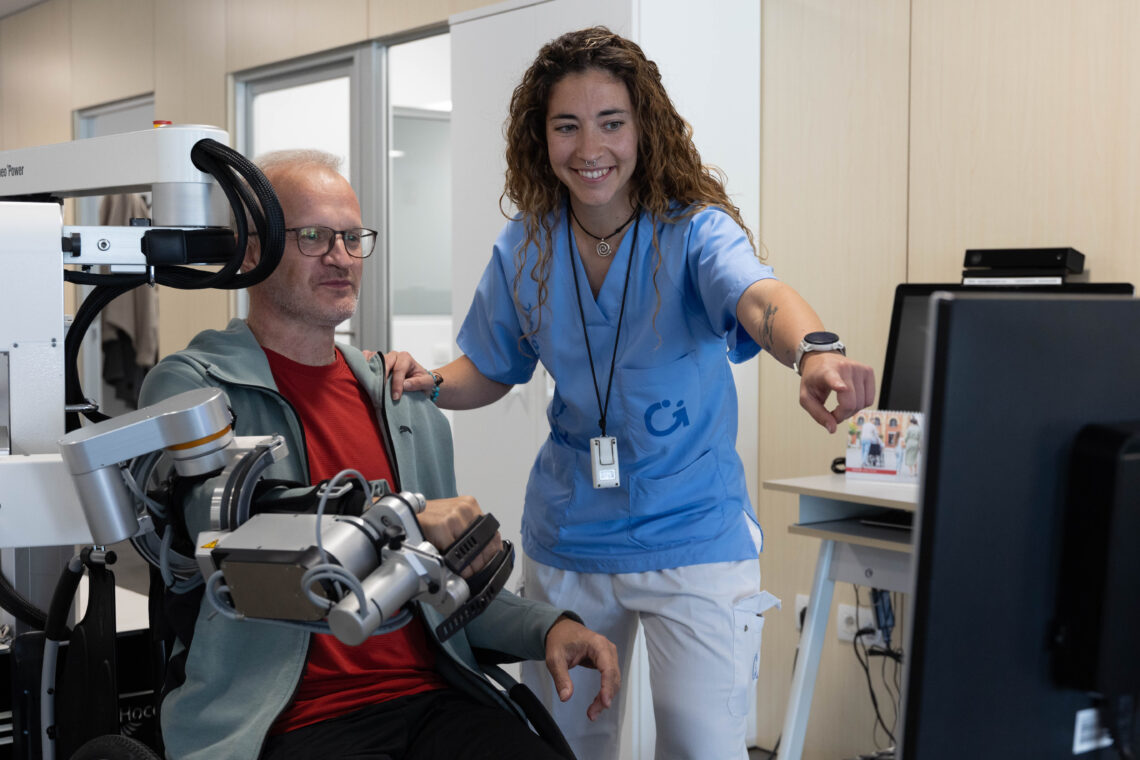
During 2025, 489 adult patients with acquired brain injury completed their specialized and intensive neurorehabilitation process, of which 17.58% were of traumatic origin (TBI, traumatic brain injury), 43.56% of vascular origin (MVC, vascular disease pathologies).
| Type of injury | Patients |
| Traumatic brain injury | 86 (17,6%) |
| Stroke (CVA) | 213 (43,6%) |
| Other non traumatic brain damage | 190 (38,8%) |
| Total | 489 (100%) |
Social situation
The average age was 50 years, and the majority of patients were male (64.69%). The most frequent level of education among the population served was secondary school, followed by primary and higher education. The demographic data is detailed in the graphs below.
Population by gender
Level of education
Upon returning to the community, individuals with acquired brain injury face a significant lack of specialized resources, particularly public ones, to support independent living. Existing services are not designed for them and they often have to rely on services intended for people with mental health conditions or intellectual disabilities, as well as nursing homes or long-term care facilities.
An analysis of living arrangements upon admission and discharge reveals some variations. There is an increase in the number of individuals returning to live with their parents after discharge, and a significant rise in the number of patients requiring institutionalization. There is a decrease in the number of individuals living with their partner and in the number of those living alone or with other close relatives (excluding their parents).
Furthermore, we assess the patient’s socio-familial situation, which helps us identify situations of social risk and implement an intervention tailored to each patient’s social needs. To analyze the socio-familial situation, we administer the EVSF-IG scale, which gathers information on five areas: cohabitation, economic situation, housing, family environment, and need for support.
According to 2025 data, in 47% of cases the patient’s socio-familial situation had improved by discharge, in 30% it remained the same, and in 23% it worsened. In the case of patients with acquired brain injury (ABI), the dimensions that present the greatest social difficulties at discharge are: lack of support from the family or household and a precarious economic situation of the family unit.
| 2023 | 2024 | 2025 | |
| It has improved | 49% | 34% | 47% |
| It remains | 24% | 33% | 30% |
| It has worsened | 27% | 33% | 23% |
Improvement of functional autonomy
To measure and evaluate the improvement in functionality of people with ACI, it is necessary to differentiate between 3 groups according to the type of injury: traumatic brain injury, cerebral vascular disease and other causes of brain damage.
TRAUMATIC BRAIN INJURY
Of the 86 patients with traumatic brain injury treated and rehabilitated, 70.27% presented with severe impairment according to the Glasgow Coma Scale upon admission. Their average age was 44 years.
One of the disability assessment scales we use is the Disability Rating Scale (DRS). This scale is a tool designed to measure the overall level of disability in people with acquired brain injury, especially in the context of severe traumatic brain injury. The DRS measures the severity of disability, from partial disability to an extreme vegetative state.
Our patients improved by an average of 4.27 points, moving from severe disability upon admission to a moderately severe disability upon discharge.
The DRS is a scale designed to assess patients who have suffered a moderate to severe traumatic brain injury (TBI). The total DRS score ranges from 0 (no disability) to 29 (extreme vegetative state); therefore, the lower the score, the better the patient’s functional status. The following classification groups are used: 2-3 partial disability, 4-6 moderate disability, 7-11 moderately severe disability, 12-16 severe disability, 17-21 extremely severe disability, 22-24 vegetative state, and 25-29 extreme vegetative state.
Regarding cognitive abilities, patients have improved in spatial orientation and in different cognitive domains such as attention, processing speed, visuo-construction, episodic memory and other executive functions.
STROKE
The average age of the 213 patients discharged from the hospital after stroke was 54 years. To assess their functional status, the Barthel Index was administered, revealing an average improvement of 23.94 points at discharge compared to admission. The Barthel Index, widely validated for these patients, measures their ability to perform activities of daily living independently (eating, dressing, personal care, etc.).
The scale ranges from 0 to 100, with 0 representing total dependence and 100 representing full functional autonomy for performing ADLs. The classification by Shah et al., Improving Index for Stroke Rehabilitation (J Clin Epidemiol 1989), was used as a reference. This classification considers the following groups: 0-20 total dependence, 21-60 severe dependence, 61-90 moderate dependence, 91-99 slight dependence, and 100 independence.
In relation to cognitive abilities, patients have improved in orientation in space and time, and in different cognitive domains such as attention, processing speed, visuo-construction, episodic memory and other executive functions.
OTHER CAUSES OF BRAIN DAMAGE
190 patients with non-traumatic brain injury from other causes, such as tumors, anoxia, and infections, have completed the rehabilitation process. Their average age was 48 years. Regarding the functional level achieved, the following figure shows how our patients experienced improvement in both cognitive and motor skills (assessed using the FIM scale). Overall, an improvement of 10.29 points was observed at discharge compared to admission.
The FIM scale measures a patient’s ability to perform activities of daily living (ADLs) independently. The FIM-Total score is the sum of the scores for the two areas (cognitive and motor), and the score ranges from 18 to 126 points. The higher the score, the better the patient’s level of functionality. The minimum score (18) corresponds to total dependence, and the maximum score (126) to complete independence.