
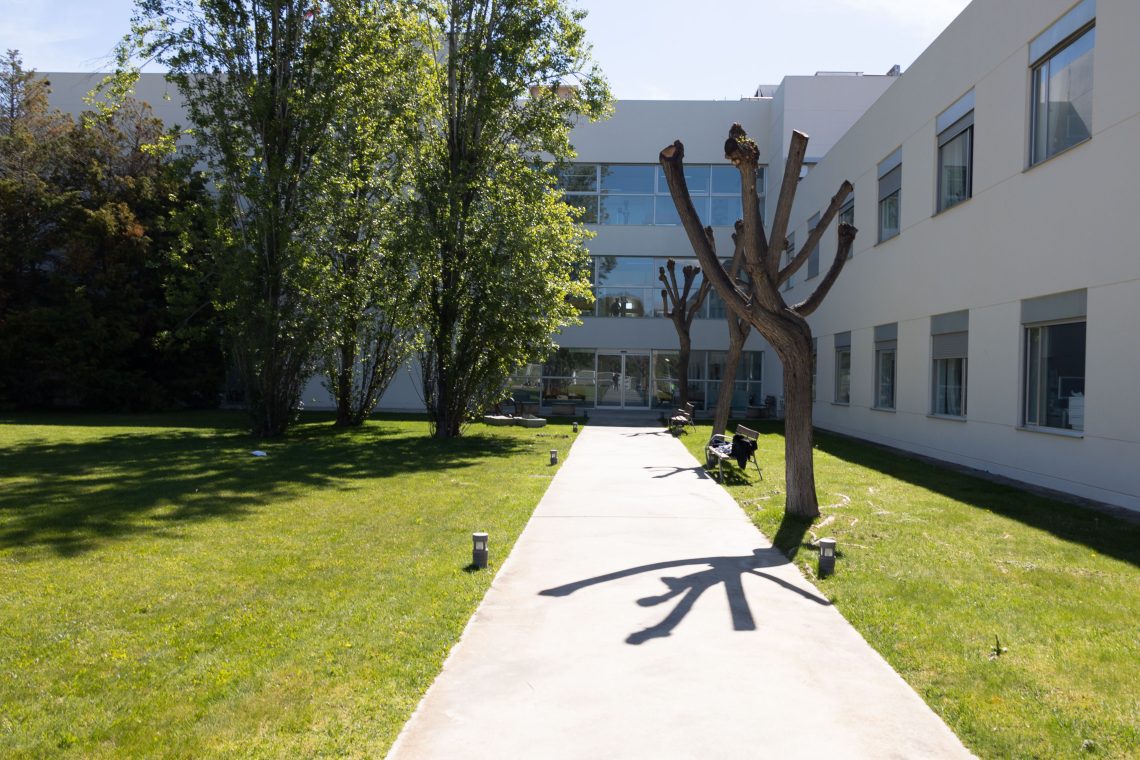
The Institut Guttmann facilities are located within the Sierra de Marina Natural Park, which is part of the Barcelona Provincial Council’s Network of Protected Natural Areas.
The plot covers 42,100 m2:
- 8,080 m2 of built-up land with hospital facilities.
- 34,019 m2 of outdoor space, of which 10,451 m2 are gardens.
The most significant impacts of the Institut Guttmann’s activities on biodiversity are defined by the area it occupies on a 42,100 m2 plot that had not previously been developed.
EMISSIONS AND WASTE
The Institut Guttmann’s emissions into the atmosphere are those derived from:
- Electricity consumption.
- Fuel consumption: Natural gas and diesel.
- Fuel consumption for own transportation.
- Waste generated.
- Water consumption in the building and garden areas.
Total emission: 1.147,3971 t CO2 eq.
The CO2 emissions calculation is performed using the Catalan Climate Change Office’s calculation tool, which has been modified in the last year, incorporating new variables for quantification.
Emissions intensity is an indicator for analyzing the evolution of the efficiency of the measures adopted to reduce greenhouse gas emissions and is calculated based on the ratio of emissions generated to annual revenue:
IE GEH: 1.147,397 t CO2 eq. / 35.695.812,77€: 0,0000321437t CO2 eq/€. We emit 0,032143 t CO2 eq. to bill 1.000,00€.
Waste. Exhaustive monitoring of the waste generated by the Badalona hospital is carried out, and no significant accidental spills occurred during 2024.
The wastewater discharged is all of the organization’s wastewater that flows into the Badalona City Council sewage system. During 2024, 0.086 tons of water contaminated with laboratory products were generated.
| Residuos sanitarios | 2021 | 2022 | 2023 | 2024 |
| Group I-II | 103,94 | 99,350 | 71,200 | 70,740 |
| Group III | 6,858 | 8,229 | 4,355 | 4,380 |
| Group IV | 0,125 | 0,006 | 0,503 | 0,119 |
| Total (t) | 110,923 | 107,585 | 76,059 | 75,239 |
| Waste similar to urban waste | 2021 | 2022 | 2023 | 2024 |
| Paper and cardboard | 22,705 | 23,090 | 22,230 | 23,440 |
| Plastic | 11,355 | 12,373 | 11,585 | 12,155 |
| Glass | 0,373 | 0,779 | 0,799 | 1,104 |
| Organic | 38,122 | 38,250 | 36,847 | 36,720 |
| Cooking oil | 0,350 | 0,480 | 0,435 | 0,375 |
| Wood | 0,700 | 6,260 | 3,580 | 5,700 |
| Iron | 0 | 0 | 0 | 0,650 |
| Plant remains | 0 | 0 | 0 | 0 |
| Total (t) | 73,605 | 81,232 | 75,476 | 80,144 |
| Hazardous waste | 2021 | 2022 | 2023 | 2024 |
| Group III | 6,858 | 8,229 | 4,355 | 4,380 |
| Group IV | 0,125 | 0,006 | 0,503 | 0,119 |
| Polluting packaging | 0,941 | 0,630 | 0,512 | 0,880 |
| Fluorescents | 0,101 | 0,114 | 0,0368 | 0,105 |
| Batteries | 0,065 | 0,157 | 0,142 | 0,200 |
| Aerosols | 0,013 | 0,008 | 0,065 | 0,006 |
| Absorbent material | 0,178 | 0,171 | 0,147 | 0,110 |
| Synthetic oil | 0 | 0 | 0 | 0 |
| Electronic equipment | 0,764 | 0,876 | 0,4240 | 1,768 |
| Phytosanitary products | 0,002 | 0,001 | 0,001 | 0,001 |
| Water contaminated with chemicals | 0,254 | 0,115 | 0,082 | 0,086 |
| Orthopedic batteries | 0,280 | 0,270 | 0,520 | 0,200 |
| Radioactive (indirect) | 0,001825420 | 0,001825057 | 0,001467378 | 0,001421080 |
| Total (t) | 9,5828 | 10,5788 | 6,78927 | 7,8564 |
Total waste (in tons)
| 2021 | 2022 | 2023 | 2024 |
| 194,35 | 199,05 | 171,59 | 171,47 |
Regarding transportation waste, the Institut Guttmann has continued its awareness-raising campaign on public transportation and carpooling, “Sustainable Mobility,” during 2024.
Thanks to this efficient environmental management, the Institut Guttmann closed the 2024 fiscal year without any fines or non-monetary sanctions for non-compliance with environmental regulations, nor any complaints or claims regarding environmental impacts arising from our activities.