
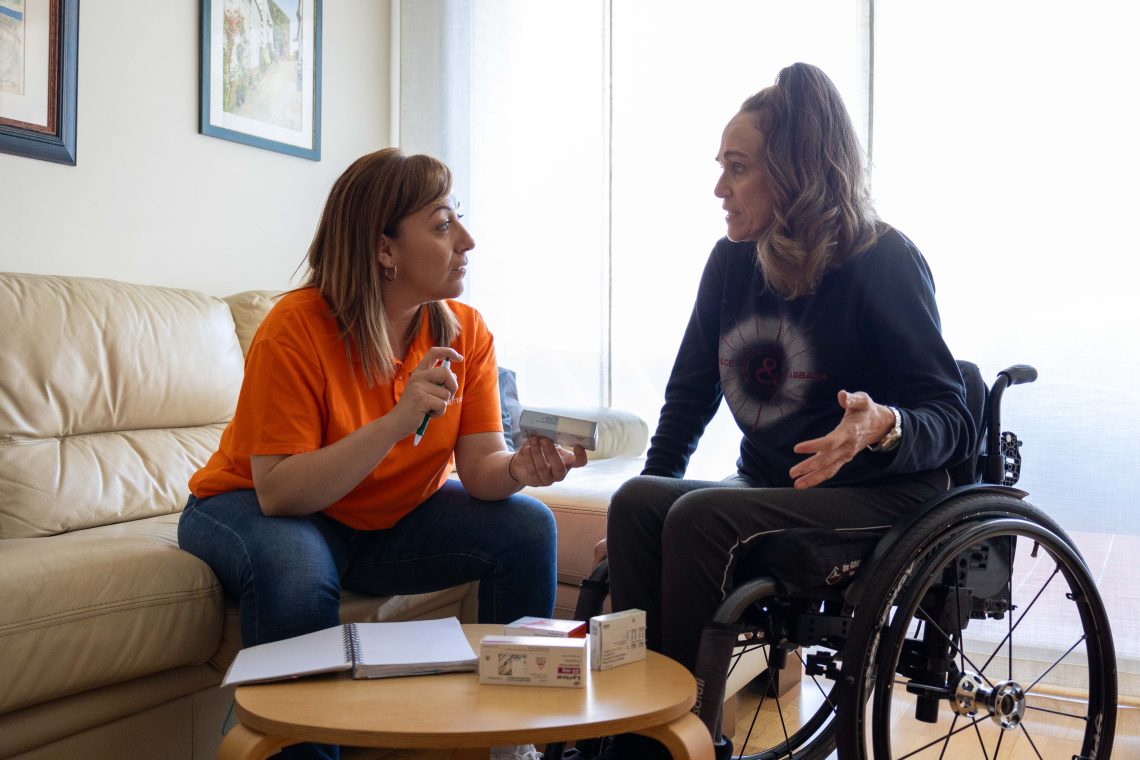
Rehabilitation takes on its true meaning and usefulness in health care when it allows people to maximise their functional autonomy and go about their lives with dignity, independence and quality of life, and active social participation, at the same time as with social participation on equal terms with others.
For this to be possible, it must be possible to guarantee that everyone receives quality rehabilitation, but it is essential to have an inclusive and accessible society that respects functional diversity and that promotes effective equalisation of opportunities.
That is what we strive to measure through the regular assessments that we perform on all our former patients over time. In this report we place special emphasis on the results corresponding to 2 and 5 years after they complete their rehabilitation process in our hospital.
In these periodic reviews, in addition to ruling out any pathology derived from their injury that could go unnoticed, their autonomy, quality of life and degree of community integration are assessed, among other aspects.
Degree of community integration
In order to assess the degree of integration in the community at 2 and 5 years after discharge, you are asked to complete the Community Integration Questionnaire (CIQ). It consists of 25 points related to competence at home, social integration and productive activities.
According to the quality indicators of the Guttmann Institute, we can conclude that the degree of community integration of our patients remains within the expected standard (≥ 4) after 2 years of discharge from the neurorehabilitation process.
However, in general terms, the level of participation and social inclusion of people with disabilities is low, given the lack of accessibility in our society. We need to continue working to improve the degree of community integration of our patients in the long term, which is very much conditioned by the barriers presented by today’s society.
Degree of global community integration 2 years after discharge
| 2019 | 2020 | 2021 | 2022 | 2023 | |
| Brain Health | 7,33 | 6,31 | 7,06 | 7,82 | 7,14 |
| Spinal cord injury | 6,75 | 7,41 | 7,44 | 6,63 | 6,24 |
If we group the items of the CIQ scale, we can obtain 3 dimensions of analysis:
- Skills at home (maximum 10 points)
- Social integration (maximum 10 points)
- Productive activities (maximum 5 points)
The higher the score, the higher the level of integration. Generally speaking, patients achieve higher levels of community integration as the years pass since neurological injury.
Community integration of the population with spinal cord injury
Community integration of the population with brain damage
Quality of life of patients with spinal cord injury:
Regarding the perception of the quality of life (based on the WHOQoL-BREF scale), at 2 years after discharge, patients with spinal cord injury show levels within the expected standards (≥ 2.5 , where 1 is very bad and 5 very good). The WHOQoL-BREF assessment scale is only given to patients with spinal cord injury.
Degree of global perception of the quality of life 2 years after discharge:
| 2019 | 2020 | 2021 | 2022 | 2023 | |
| Spinal cord injury | 3,15 | 3 | 3,04 | 3 | 2,86 |
| 2019 | 2020 | 2021 | 2022 | 2023 | |
| Anxiety | 7,32 | 7,85 | 6,88 | 8,13 | 6,50 |
| Depression | 7,68 | 7,85 | 5,60 | 8,63 | 6,69 |